
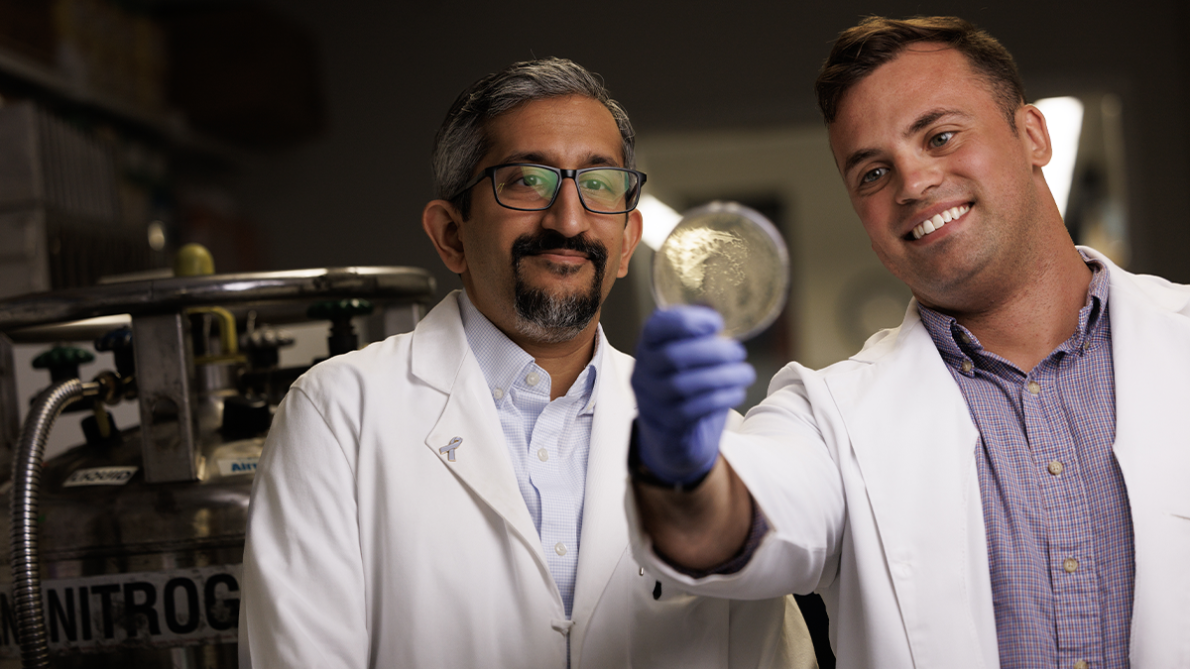
A three-year study from Duke University School of Medicine has uncovered a previously unknown way that the body's most common drug targets communicate inside cells,
The research team, led by associate professor of medicine Sudarshan Rajagopal, MD, PhD, and MD-PhD student Preston Anderson, found that β-arrestin proteins form liquid-like droplets called biomolecular condensates near G protein-coupled receptors (GPCRs). These tiny clusters act as signaling hubs, organizing molecular activity in specific locations within cells.
The data published in Nature on Wednesday, May 27, 2026 could point researchers toward new approaches in drug design.
GPCRs are the targets of roughly one-third of all FDA-approved drugs, including beta-blockers, antihistamines, and medications used to treat shock, heart disease, and asthma. The human body contains nearly 700 GPCRs, yet only two β-arrestin proteins regulate their activity. How two proteins manage hundreds of receptors had been a longstanding puzzle.
"Our work shows that these receptors that essentially regulate every aspect of physiology signal using a way that we didn't appreciate before," Rajagopal said. "That's important because it's potentially druggable; it suggests that there might be different ways to target GPCR signaling that take advantage of their use of these condensates."
The key experiment came from an unlikely moment. Anderson conceived the idea while watching clouds drift and merge during a beach vacation at Kure Beach, North Carolina. That night, he sketched a proposal: attach two halves of a bioluminescent protein to the tail ends of β-arrestins to see whether they would glow when the proteins clustered together. When he sent the sketch to Rajagopal, his mentor told him it wasn't going to work, according to the university's account. Anderson ran it anyway.
It glowed.
When the team disrupted the condensates experimentally, GPCR signaling broke down, directly linking the structures to receptor function.
The discovery builds on decades of GPCR research at Duke. Robert Lefkowitz, MD, a Duke investigator, shared the 2012 Nobel Prize in Chemistry for defining how these receptors work and discovered the arrestin protein family itself. Anderson's interest in the field was shaped during clinical training in the COVID-19 pandemic, when he treated patients in shock with GPCR-targeting drugs like norepinephrine and vasopressin that have changed little in decades.
The study, funded by the American Heart Association, the Mandel Foundation, and the National Institutes of Health, involved more than 20 co-authors across Duke and collaborating institutions. Because the condensates organize signaling at specific cellular locations, the team says they may eventually allow drugs to target certain pathways while leaving others untouched, a precision that current GPCR drugs lack.